
Wandering Hours, Centred Design
In a watch market flooded with sterile reissues and gimmicky complications, the Merkur Pierre Paulin Star Wheel stands out as a rare gem, a watch that confidently straddles vintage aesthetics and mechanical intrigue without losing its soul to overproduction or trend-chasing.
Who Is Pierre Paulin?
Pierre Paulin was a celebrated French designer known for his bold, sculptural furniture pieces that defined modernist interiors of the 1960s and 70s. His work seamlessly blended ergonomics with avant-garde form, most notably seen in the iconic Mushroom Chair and Ribbon Chair. His aesthetic was fluid, futuristic, and playful, often incorporating sweeping curves and unexpected silhouettes.
Here’s the interesting part: Paulin had no connection whatsoever to watches, let alone the brand Merkur. Which is why the choice of his name for a watch lineup feels almost surreal. It’s the sort of move you often see from Chinese manufacturers—latching onto a name, or design, or legacy that already carries weight, even if the link is paper-thin. More an opportunistic branding quirk that can lead to curious mash-ups like this.
Why Pierre Paulin and not another designer? That’s harder to pin down. Maybe it’s the retro-futuristic design language that loosely aligns with the watch’s cushion case and playful dial. Maybe someone at Merkur is genuinely a fan of his furniture. Or maybe it was as simple as the name sounding sophisticated and European. Whatever the reason, it’s an odd but oddly fitting choice. The Star Wheel’s layered textures, unusual complication, and unconventional aesthetic do echo the nonconformist spirit Paulin was known for.
Design That Leans Into the Past
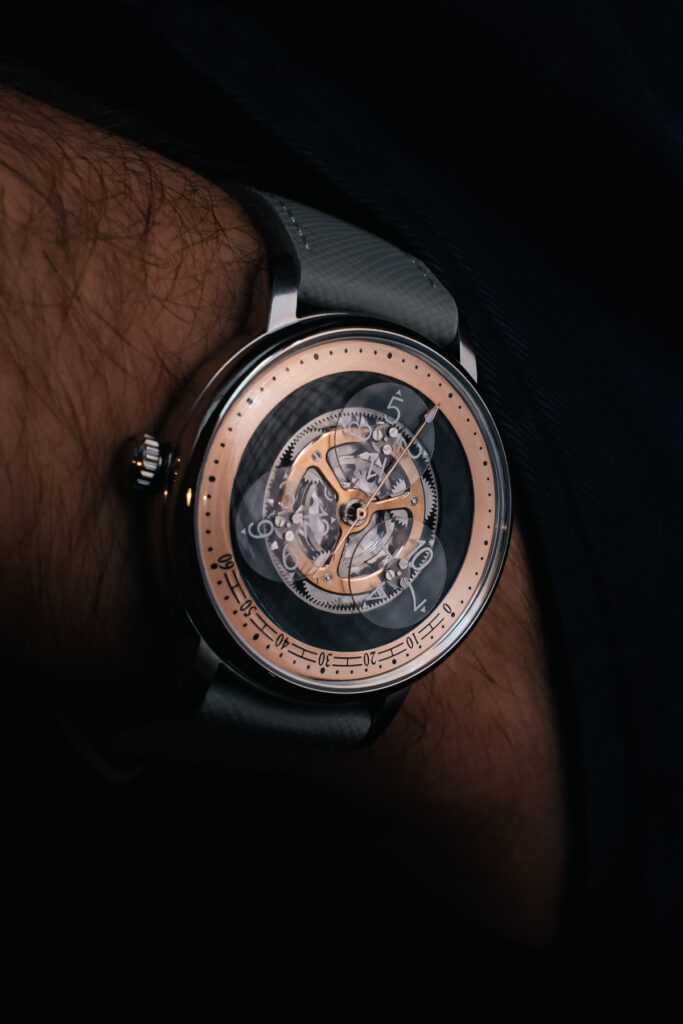
At first glance, the Star Wheel looks like a time capsule from the golden era of experimental 1970s design. The case shape is unapologetically retro, cushion-style with clean radial brushing, exaggerated chamfers, and just the right amount of heft. But the real magic lies in the dial and its layers.
The midsection of the dial is adorned with Geneva stripes, an unexpected flourish more often reserved for high-end movement finishing. It’s a quiet nod to traditional watchmaking, contrasting beautifully with the industrial, almost architectural look of the outer track.
Surrounding the dial is a subtle copper-salmon ring, a hue that deserves its own applause. Salmon dials are tricky. Some go too pink, others lean orange or end up too glossy. Merkur has nailed something special here. Their take is muted, warm, and effortlessly elegant, a salmon that whispers rather than shouts.
As a collector who loves seeing how brands interpret “salmon” in their own language, this one hits a sweet spot. It doesn’t try to impress with flash. Instead, it earns admiration slowly, with its soft metallic glow and well-balanced layout.
Inside the Case
The Merkur Pierre Paulin Star Wheel uses the reliable Miyota 82S0/82S5 automatic movement as its base, known for dependable performance and straightforward servicing, easily on par with Seiko’s NH lineup. Built on this foundation is a wandering hours module, an additional mechanical layer mounted above the standard calibre. Who exactly makes this module is unclear. Merkur is known to work with private-label Chinese complication specialists, but despite repeated attempts to get an official answer, including interview requests and detailed questions sent via email and Instagram, the brand did not respond. That silence leaves the origins of the module a mystery, adding a layer of intrigue to the watch’s story.
What is certain is that the module transforms the basic three-hand movement into a far more engaging complication, demonstrating design ambition while keeping the watch affordable.
Origins of the Wandering Hours Complication
The wandering hours complication traces back to 17th-century Italy and Pope Alexander VII. Struggling to sleep, he confided to his secretary, Cardinal Barberini, that the constant tick-tock of the clock in his quarters kept him awake—and when he did wake, the pitch-dark room made it impossible to read the time. Whether the culprit was truly the noise or simply the weight of papal responsibility is unclear, but the request for a quieter, more legible timekeeper was clear. The Campani brothers, renowned Roman clockmakers, responded with a clever solution: a mechanism where the hour “wanders” along a fixed arc of minutes, gliding silently across the dial.
This not only solved the Pope’s practical problem but also introduced one of horology’s most poetic complications, blending mechanical ingenuity with a graceful, almost meditative way of displaying time.
Centuries later, Audemars Piguet revived the concept in the early 1990s with their original Star Wheel, which used sapphire discs to carry the hours across a central wheel. It was a clean, modern take that captured enthusiasts’ attention. Urwerk took the idea further with avant-garde satellite discs, while brands like Gorilla and Arnold & Son have introduced their own interpretations. Despite its complexity, the wandering hours display remains rare and often tied to high price points, making Merkur’s take refreshingly attainable.
Wandering Hours Without the Wallet Pain
Star wheel, or “wandering hours”, displays are usually reserved for the horological elite. Audemars Piguet famously revived the complication in the 1990s and brought it back recently in their Code 11.59 Starwheel, complete with aventurine dial and ceramic case. Urwerk pushed the concept into sci-fi territory with their UR-100 and UR-101 series, while Gorilla Watches gave it a motorsport-inspired edge.
Merkur’s approach strips away the exclusivity without losing the charm. It’s an accessible way to experience a complication typically reserved for collectors willing to spend five figures.
Final Thoughts
The Merkur Pierre Paulin Star Wheel is a perfectly funky watch that feels like a no-brainer to own. Being able to experience a complication like this at such an accessible price point is an absolute treat. It’s your “I felt like wearing something interesting” pick, an exceptional conversation piece that often leaves people stunned after hearing the price.
Between the Geneva-striped dial, the elegantly quiet copper/salmon accents, and the custom-finished rotor, Merkur has built something that feels like it belongs in a far higher price bracket. And in a world where star wheel watches are usually locked behind five-figure price tags and brand prestige, this one’s a breath of fresh air.
Pros:
– Accessible price for a rare complication
– Distinctive retro design with quality finishing
– Custom rotor and Geneva-striped dial add refinement
Cons:
– Unknown origins of the wandering hours module
– Limited brand transparency
– Not a daily driver for all tastes
Quality: 82 – You get what you pay for here. The movement, as seen through the display caseback, is undecorated and rather plain, but the dial quality and timekeeping are excellent. The visible gearing and finishing through the front are well executed.
Style: 88 – Undeniably versatile for most occasions; dress, everyday, or super casual wear. Maybe not for fishing or hiking, but it pairs well with almost anything (though that could just be down to my own style… or lack of it).
Value: 90 – One of the most impressive “bang for your buck” pieces I’ve come across. Reliable calibre, an incredible module and display, plus a domed sapphire crystal that completes the premium feel.
Wearability: 85 – Very versatile on the wrist, but in hot weather, the stiff leather strap can be an annoyance, which slightly dents the overall comfort score.
Photo credits: @boysntime

Leave a Reply
You must be logged in to post a comment.